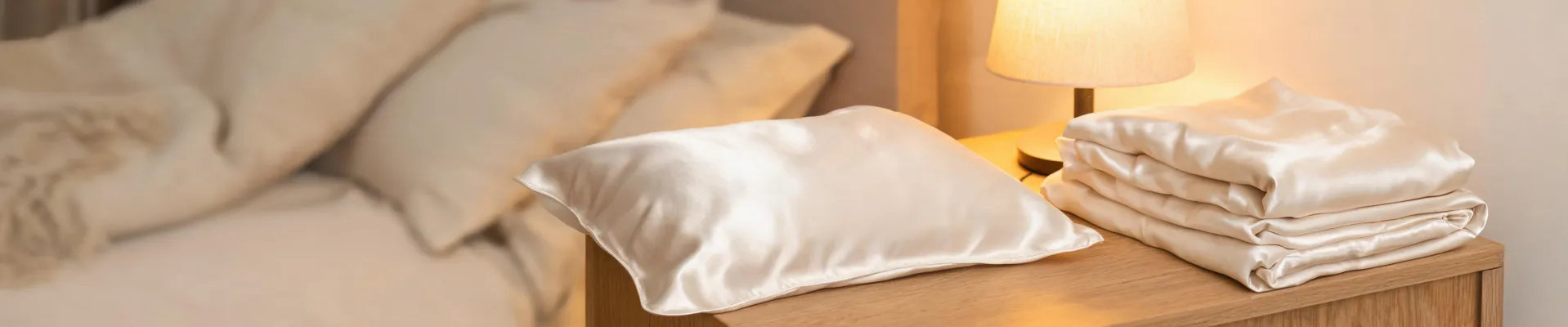
Blissy 22-Momme Mulberry Silk Pillowcase Reviews: A Reality Check
2026-09-04 by Ingrid Falk
The crease on your cheek catches you first, and the frizz at your temple follows. A cotton pillowcase did most of the work through the night. That search for 'blissy 22-momme mulberry silk pillowcase reviews' is therefore one practical question: can a denser silk weave undo what night friction started, or is the number only a promise?
The morning crease: what made you google this pillowcase?
That mirror check is a diagnostic, not just vanity. Cotton fibers are irregular and hard enough to catch the edges of your hair cuticle and the folds of your skin, so every shift against the pillow adds small tugs. By morning those tugs stack into visible frizz and a crease that lingers halfway through your coffee. The moment you notice them, you start guessing which change would help: a different serum, more water, a new sleep position. A '22-momme' label sounds precise. It says the fabric is dense, but density alone does not tell you whether the surface is smooth enough to let hair and skin glide overnight. The number you typed into the search bar carries a promise, yet to feel that promise in the morning you need to understand what makes it deliver. You are not shopping for a thread count; you are shopping for a friction level, and the label is only a clue.
Does that mean Blissy is worth your money? Not automatically. A high-quality 22-momme mulberry silk pillowcase can still be reasonable, but only if the label is honest and the material is pure. The brand's homepage will tell you it loves silk; it will not tell you whether this particular pillowcase is made entirely of mulberry silk or whether the momme number is printed where you can check. Softness is a feeling; spec is a fact. A pillowcase can feel soft even when part of the fiber is blended, yet the anti-frizz benefit comes from the smooth surface of pure mulberry silk. Neither detail comes from a homepage visit; each one has to be confirmed on the product you open. That gap between marketing and verification decides whether this pillowcase solves your morning problem or simply adds a luxury routine.
Why 22-momme mulberry silk can change friction
Here is what the number means physically. Momme is a weight unit for silk fabric: one momme equals roughly 3.75 grams per square meter, so a higher momme count means a heavier, denser weave. A 22-momme cloth has more silk filaments per square inch than a lighter 19-momme cloth, which tends to make it more durable and less likely to wrinkle by morning. Density is only half the story. Mulberry silk comes from silkworms fed on mulberry leaves; its long, continuous filaments create a smooth surface. When hair presses against that surface, strands slide rather than grip; when skin moves across it, friction falls well below cotton. That is why silk pillowcases became a skincare and hair-care staple. The mechanism is straightforward: smoother filaments create less pull, and a denser weave keeps that smoothness working longer—provided the fabric is truly pure mulberry silk. No blend of synthetic or lower-grade fibres can reproduce that combination; it changes the surface and eventually the glide.
The tagline on Blissy's homepage says 'Leading The Silk Revolution,' with a countdown offering 'Up To 5 % OFF.' That on its own is ambition, not a specification. The same page opens into pillowcases, bonnets, sleep masks, loungewear, candles, and many licensed collections. A wide catalogue means the company has scale; it does not confirm that the 22-momme pillowcase is 100% mulberry silk. Scroll further and you see shade names and prints from Hello Kitty to Harry Potter, but no sentence about weave or material content. The absence is not proof of a bad product; it simply means the homepage creates desire rather than giving you data to judge. Look at the product photos: they flatter, they do not inform. If the 22-momme claim were the brand's best evidence, it would sit beside the price, not beneath a menu of colors and collabs.
What Blissy's official pages actually let you see
The official collections page and the about page reveal plenty, but not textile quality. Between them, they display dozens of ranges, from licensed Hello Kitty prints to a 'Sherbet Striped Collection,' plus bonnets, travel pillows, and rows of color names. The About Us page repeats the catalogue and frames the company as the silk-revolution leader. A visitor can browse for an hour and never find a fabric-construction detail or a momme number. The word 'momme' itself never appears in the visible official text; the only numbers belong to a promo timer. That contrast is the value of the evidence: official pages confirm the scope of a silk-lifestyle brand, not the specification of one pillowcase. They prove scale and positioning; product-level evidence—the real composition behind the 22-momme label—is missing. That is not an accusation of fraud; it is a boundary between what the website can sell and what your skin needs to know.
Read those pages as a practitioner would: separate what the brand can show from what only a product can show. Brand-level facts are easy—Blissy has a large website, many collections, famous collaborations, and a confident tagline. Product-level facts are harder—the fabric composition of a specific case, the momme count printed on its own label, and the care instructions that tell you how it will behave after washing. The two levels should never be merged. A large official store creates a halo of credibility, yet the halo sits on marketing, not on yarn. When you move from the homepage to checkout, look for the material tag or the product description's composition line. If the wording cannot state '100% mulberry silk,' then '22-momme' is an incomplete sentence. That does not mean Blissy is lying; it means the evidence you have is insufficient for the price you might pay. The same logic protects you if you ever compare this pillowcase with another brand: one search for 'composition + care + momme' beats an hour of admiring product photography.
Do not stop at the number: the momme-only trap
The trap begins when '22-momme' becomes a magic number. Momme is a density measure, not a purity measure. A 22-momme satin can, in theory, use blended fibre or finishing treatments and still carry the number on a tag. Stop at the number and you miss the question that matters: what is the material? The anti-friction surface comes from continuous mulberry silk filaments, not from weight alone. Blissy's large official store makes this error more attractive because a polished site invites trust by association. Scale is a business signal; it says nothing about fabric composition. A big catalogue and a 'silk revolution' slogan do not put mulberry silk on the label. The 22-momme label gains meaning only when composition is stated separately, because a high count by itself cannot distinguish pure silk from a dense blend. That is the trap to correct when a reader assumes that a big, professional brand automatically offers premium 22-momme silk. Finally, verify silk purity.
Here is the uncomfortable middle you are actually in. You want a premium mulberry silk pillowcase; Blissy looks credible because its catalogue fills the screen; yet the official spec you need is not visible. If you buy on the homepage halo, you accept that the label might be right just because the marketing is confident. If you refuse to buy, you risk giving up a product that could be genuinely good. The honest route through the dilemma is to ask two questions before checkout: does the listing state 100% mulberry silk, and does the tag include '22 momme'? Put that question to customer service before you enter payment details; a written answer that names mulberry silk is worth more than a row of product shots. When both answers are yes, Blissy stays a candidate; when either answer is vague, treat the brand story as decoration, not as evidence.
The rule to keep before you hit checkout
Keep one rule in view: a momme number is a reason to inspect, not a reason to buy. A claim of '22 momme' means something only when it rides on a second fact: 100% mulberry silk. Composition gives you the smooth, low-friction surface; density tells you how durable that surface will be. Blissy is worth considering because it is an established silk-lifestyle brand with a large official range and a confident silk-revolution position. But that position is a business claim; it does not verify the pure material or the label on the pillowcase you receive. If the seller cannot confirm both in writing, the 22-momme number is only a sales tag. Use the same check for Blissy as for any other brand, and the decision becomes less about loyalty and more about verification.
Return to the morning when you saw the crease and the frizz. The original question was not whether silk feels luxurious; it was whether hair and skin would glide instead of catching. With the rule in front of you, the night before that mirror becomes a sequence: check label, confirm composition, verify momme, then sleep. If the case carries '100% mulberry silk' and '22 momme,' give it a real trial and let your hair be the judge. If those details hide behind homepage slogans, keep your money and move on. The same morning check that created the search now answers it: one glance at the tag tells you whether the pillowcase earned its place on the bed.
So the verdict stays on the product label, not on the brand page. If the case says 100% mulberry silk and 22 momme on the tag, give it a few nights and watch your mirror; if it only repeats a silk-revolution slogan, the revolution can wait until a spec sheet arrives.

Ingrid Falk
Ingrid Falk is an outdoor living products analyst specializing in fences, pergolas, gazebos, canopies, greenhouses, shade sails, patio sets, outdoor sofas, and weatherproof cushions. She uses ISO 4892-2 and ASTM G154 weathering methods while comparing UV color change, coating adhesion, corrosion resistance, frame load, joint stability, water shedding, and dimensional movement. Her work helps garden retailers, project buyers, and hospitality operators select structures and furniture suited to wind exposure, climate, installation method, maintenance, and expected occupancy.