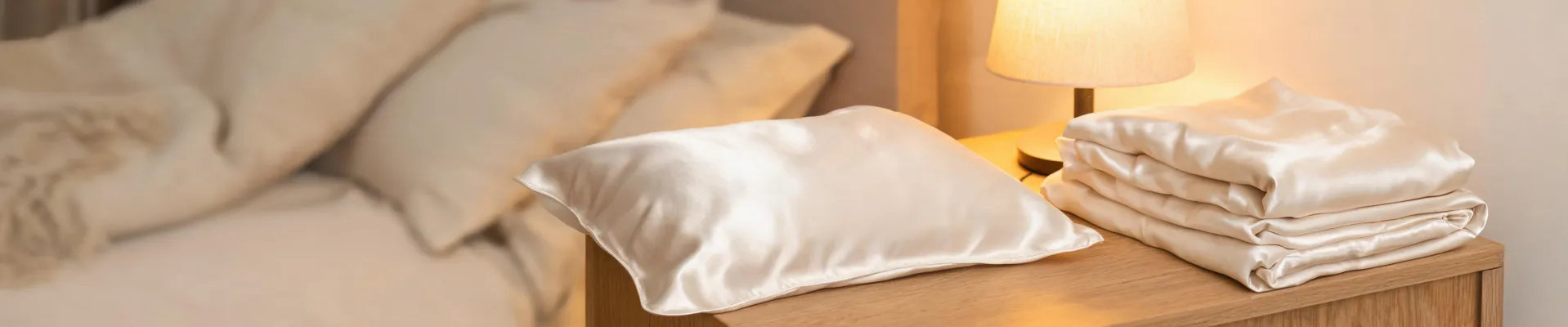
The Unboxing That Matters: How to Judge Blissy 22-Momme Silk Pillowcase Reviews
2026-08-14 by Ingrid Falk
You have just unboxed a Blissy 22-momme mulberry silk pillowcase. The fabric feels cool and smooth, and the label repeats the number that sold you. For a moment, the promise of softer hair and calmer skin seems real. But as you hold it to the light, a doubt surfaces: is this weight alone proof of quality, or just a reassuring figure? Most reviews never answer that. Let's look at what the number really tells you.
You just unpacked a Blissy pillowcase
At the start, when you slid the box open, the pillowcase emerged in a smooth, cool fold. It caught the light differently than cotton, with a liquid shimmer that felt luxurious. The tag repeated the words 22 momme mulberry silk, and the premium price suddenly seemed justified. For a moment, the entire promise of better hair and calmer skin felt tangible. But as you ran your fingers across the weave, a question began to form—one that most review threads never address directly. Is this number on the label actually telling you what you think it tells you? The box itself felt like an event. The gap between what a product claims and what it delivers is exactly where careful shoppers lose their money.
The question is not whether Blissy makes a nice pillowcase—it probably does, and thousands of reviews will tell you so. The sharper question is whether "22 momme" and "mulberry silk" are enough to justify both the price and the promise. When you search for reviews, you will find a mix of glowing five-star notes about skin and hair, a few complaints about wrinkles or pilling, and plenty of marketing language that echoes the product page. So how do you separate the signal from the noise? How do you know if the 22-momme claim is a real quality indicator or just a number that sounds impressive? The answer starts with understanding what momme actually measures—and what it doesn't.
22 momme: the weight that starts the conversation
Momme is a weight measure for silk fabric—roughly the weight of a 4.5-by-100-yard piece in pounds. A 22-momme fabric is heavier and denser than common 19-momme, so it feels more substantial and drapes with more body. Heavier silk usually means better durability, so the number isn't meaningless. But momme tells you about density, not quality or purity. You can have a 22-momme fabric made from low-grade silk or blended with other fibers, and the number alone won't reveal it. Blissy's marketing leans on 'Leading The Silk Revolution'—official pages repeat it—but that slogan is about brand ambition, not verified specs. So when a review quotes '22 momme' as proof of premium quality, treat it as a starting point, not a conclusion. That distinction is the first step in reading reviews.
Mulberry silk, specifically, comes from silkworms fed on mulberry leaves, and it is the longest, most uniform silk fiber available. That uniformity is what gives mulberry silk its smooth, non-irritating surface—smooth enough to reduce friction on hair cuticles and skin, which is the mechanism behind most of the beauty benefits. But "mulberry" on a label is not a certification. It is a type of fiber, and it can be mixed with other silks or processed with chemical finishes that change its behavior. A pure 22-momme mulberry silk pillowcase should feel cool, have a tight weave, and not show loose threads when you pull gently at the seams. When you look at reviews, search for people who mention the feel of the fabric after several washes, or who describe how the pillowcase holds up to a night of tossing. Those details are more informative than the word "mulberry" repeated three times.
If you browse Blissy's official site, you'll find a catalog that reads like a lifestyle magazine: pillowcases, hair care, sleep masks, loungewear, candles, and dozens of themed collections. The product pages are full of color swatches and collection names, but the technical specifications are surprisingly thin. That's a pattern for brands selling a premium story rather than a measurable spec. It doesn't mean the pillowcase is bad—it means you have to verify independently. Look for the care label, fabric weight, and fiber percentage. If a review only repeats brand language and never mentions a care-label detail, it's probably echoing marketing instead of reporting experience.
Reading Blissy reviews with a practitioner's eye
A practitioner reads reviews the way a mechanic listens to an engine: for specific, verifiable sounds rather than general praise. The first filter is specificity. A review that says "my hair feels softer and I wake up with fewer wrinkles" is reporting a subjective outcome, which tells you nothing about the fabric. A review that says "after three washes, the weave is still tight and the surface hasn't pilled" is giving you a data point you can use. The second filter is the curve of expectation. Silk pillowcases are not magical; they reduce friction and absorb less moisture than cotton, which helps with some people's hair and skin, but they do not erase wrinkles or stop hair loss. If a review promises dramatic results, be suspicious. Good reviews tend to describe modest, consistent improvements and a change in how the bed feels at night, not a skin-care miracle.
When you read Blissy's About Us page, the same pattern continues: it reinforces the brand's identity and product range—'Leading The Silk Revolution,' our story, our collections, our collaborations. Brand pages are supposed to build enthusiasm, but this tells you where the company's energy goes: into lifestyle, aesthetic, and community, not into independent test results. That's a red flag only if you mistake lifestyle language for technical evidence. The green flag is a care label that says 100% mulberry silk, a checkable fabric weight, and a return policy that lets you test the feel. In reviews, such comments mention the care routine—hand washing, air drying—because they show the reviewer actually lived with the product. Red flags are phrases like 'life-changing' or 'zero wrinkles ever' without any mention of fabric behavior.
So before you click buy, ask: what evidence would change your mind? If you only want the aesthetic, a reasonably priced 19-momme option might do. If you want hair and skin benefits, you need genuine 100% mulberry silk with a weave that survives laundering. And to trust reviews, read for details—feel, washing behavior, comparison to cotton—not for star count. The question is not 'is Blissy good?' It is 'what does this review tell me about this fabric?' That question cuts through the marketing. And it applies to every pillowcase, not just Blissy.
What actually changes after the first wash
The moment a pillowcase becomes a real object is the first wash. High-momme silk is more durable, but it still needs gentle treatment. Most silk-care labels recommend hand washing or a delicate machine cycle in cold water, using a mild detergent designed for silk, and never tumble drying or wringing. If a 22-momme pillowcase is washed properly, it should keep its sheen and structure for years; if it is tossed into a normal load with towels and dried on high heat, it will dull, pull, and lose its smooth surface. When you read reviews, look for the people who mention how the case survived repeated washing, because that is where the real quality shows up. A cheap 19-momme case might feel fine out of the package but degrade quickly; a dense 22-momme fabric that is cared for can look almost new after dozens of cycles. The care routine is not a side note—it is half of the equation.
The Blissy catalog, as you'll see on its product pages, is vast—collections like 'Melody & Kuromi,' 'Sherbet Striped,' 'Cherry Espresso,' and color names from Azure to Zebra. This breadth is part of the appeal: the pillowcase is a fashion accessory to match your bedroom. But that framing sets expectations. This is a lifestyle product first; the technical specification is secondary. So when a review praises the color selection but says nothing about weave or laundering, it's telling you about the lifestyle experience, not fabric performance. Set expectations accordingly. If you buy for color and aesthetic, you'll likely be happy. If you buy for measurable hair and skin benefits, verify the construction independently and be ready to care for it properly. The two goals are different.
Back to the unpacked pillowcase
Picture that box again, the one you opened at the start. The pillowcase is still in your hand, and now you know what to look for. You turn it inside out and check the seam—are the stitches tight and even? You read the care label—does it say 100% mulberry silk, 22 momme, and give you washing instructions that promise a lasting finish? You think about how you will actually wash it, not just how it looks on the bed. The unboxing moment is lovely, but the real decision lives a season later, after the tenth wash, when the fabric has either kept its promise or started to pill.
Here is the verdict rule: treat '22 momme mulberry silk' as necessary but not sufficient. If the label says 'mulberry blend,' 'silk-touch,' or just '22 momme' without mulberry, the case is weak. If the care label matches and you'll follow washing instructions, the price is fair. If a review gives specific details about weave, washing, and feel after months, it's doing the work the brand should have done. Blissy's own pages will tell you about the revolution and collections, but they won't verify the fabric spec. That verification is on you, and now you have the tools. The rule is simple: you're buying a fabric that behaves well in your life, not a number on a tag.
The box is open, the fabric is in your hand, and the verdict rule is yours. 22 momme starts the conversation; weave, purity, and care finish it.

Ingrid Falk
Ingrid Falk is an outdoor living products analyst specializing in fences, pergolas, gazebos, canopies, greenhouses, shade sails, patio sets, outdoor sofas, and weatherproof cushions. She uses ISO 4892-2 and ASTM G154 weathering methods while comparing UV color change, coating adhesion, corrosion resistance, frame load, joint stability, water shedding, and dimensional movement. Her work helps garden retailers, project buyers, and hospitality operators select structures and furniture suited to wind exposure, climate, installation method, maintenance, and expected occupancy.